About This Book
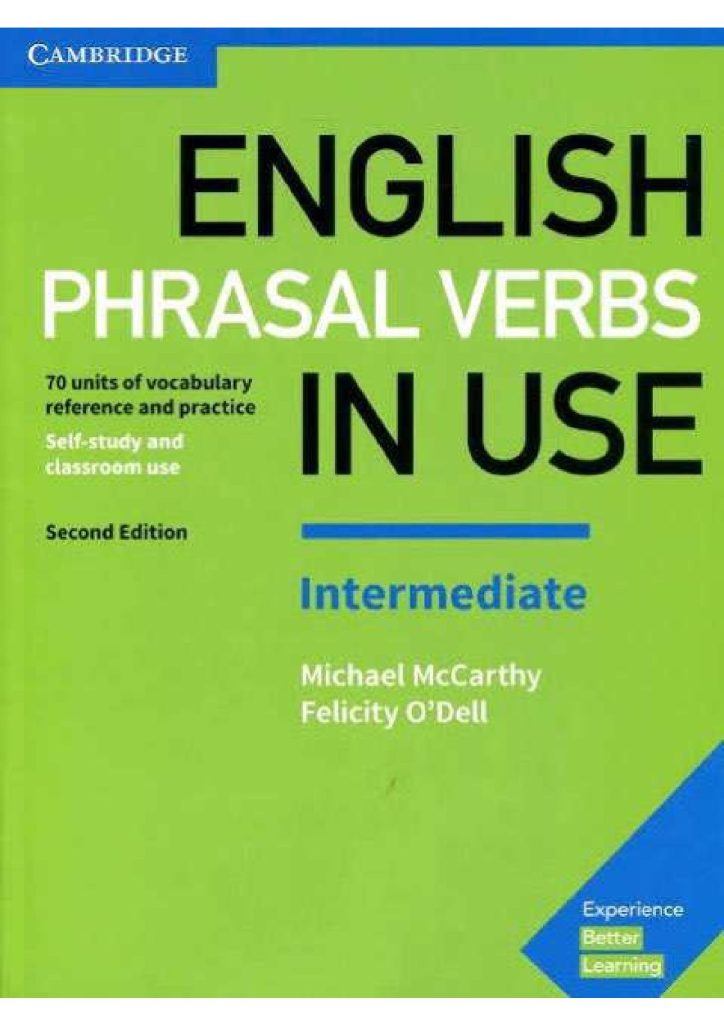
English Phrasal Verbs in Use Intermediate Book is the intermediate level of the In Use family’s phrasal-verbs line. The destination heading gives the exact title; the file served there, ‘English Phrasal Verbs in Use Intermediate Book.pdf’, carries the exact title itself — the same volume under the filename the site serves it by. The book’s work is the core repertoire: the phrasal verbs of everyday English, organised and practised until the intermediate learner can both understand them on contact and risk using them.
Every learner of English meets the same ambush somewhere around the intermediate years. The grammar is coming under control, the reading is widening — and then a native speaker says they will ‘look into it’, ‘put it off’, and ‘get back to’ them, and the sentence dissolves. Phrasal verbs are not a decoration on English; they are its default machinery for daily life, preferred by native speakers precisely where learners were taught the formal single word. The intermediate volume of a series like this exists to close that gap at the moment it opens: it selects the combinations with the highest daily yield, presents them grouped and in context — the In Use family’s signature discipline — and practises them until recognition stops requiring translation. Its intermediate pitch is itself a kindness: not the whole idiomatic ocean, which belongs to the advanced volume, but the repertoire that unlocks films, conversations, and workplace English now. The learner who finishes it has not mastered phrasal verbs — nobody finishes them — but has crossed the line where they stop being the reason listening fails.
What Learners Will Practise
Recognition on Contact
Learners practise meeting the core combinations in context until the meaning arrives whole, without unpacking the parts. Speed of recognition is the real syllabus of listening.
First Production
The book practises daring to use them — the intermediate risk that separates knowing-about from knowing. Items practised in exercises must be risked in speech to become the learner’s own.
Grouping by Verb and Particle
Readers practise the family’s organisation: verbs in families, particles by their felt logic, so the repertoire hangs together as a system rather than a heap. Systems are remembered; heaps are revised and forgotten.
Key Features
The core selection is the feature: the highest-yield everyday combinations, at honest intermediate pitch. The In Use context-first method is the second — items in use, then practised — and the shelf fit the third, the gateway beside this list’s advanced volume and its IELTS vocabulary. On this shelf it opens the idiom door here.
Who This Book Is For
Intermediate learners are its first audience, whose listening keeps dissolving on idioms. Teachers form its second readership, adding naturalness to structured courses. Self-studiers make its third, decoding the English they overhear daily.
How to Use This Book
Work through in the family’s rhythm — presentation, then practice — and keep the notebook habit: every phrasal verb you hear this week gets hunted in these pages. Say the items aloud in their example frames; the mouth learns what the eye only recognises.
Related Books
The series’ advanced volume stands at English Phrasal Verbs in Use Advanced, and the shelf’s advanced IELTS vocabulary at English Vocabulary for IELTS Advanced Book.