Grammar and Punctuation Workbook 2

Grammar and Punctuation Workbook 2 is the second-year practice book for English grammar and punctuation: the workbook where the sentence basics learned in year 1 grow into real writing skills.

In year 2, children stop merely copying sentences and start composing them — and composing is where grammar earns its keep. Workbook 2 gives that stage its practice: short, friendly teaching followed by exercises pitched exactly at a seven-year-old’s reach, building the automatic habits (a capital to start, a full stop to end, the right verb form) that free a young writer to think about what they want to say.

It is made for second-year primary students (roughly ages 6–8), their English teachers, and parents practising alongside school.

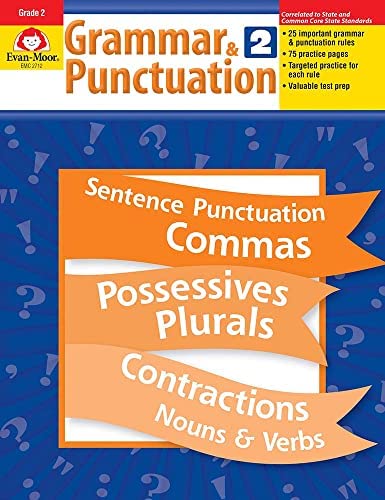
Grammar and Punctuation Workbook 2 cover

The second workbook builds directly on the first year’s foundations and widens every strand. Sentences become types — statements, questions, commands and exclamations — each with its end mark; nouns divide into the everyday and the naming kind (with capitals to match); verbs step into the past (-ed endings and the common irregulars a seven-year-old actually uses); adjectives arrive to describe and adverbs to tell how. Punctuation consolidates capitals and full stops, adds question and exclamation marks in real use, and introduces the comma in lists — the first comma a child ever needs. The format stays the series’ strength: one clear point per unit, examples a child can read alone, then the three-step climb of exercises — spot the answer, fix the mistake, write your own — with short writing tasks closing units so grammar lands in composition, not just in drills. Teachers get year-2 grammar sequenced and print-ready, ideal for morning work and homework; parents get practice that mirrors the classroom, including the vocabulary of grammar itself (noun, verb, adjective) that children now meet in school and bring home as questions.

About This Book

This is a second-year English grammar and punctuation workbook: sentence types and end marks, common and proper nouns, past-tense verbs, adjectives and adverbs, and the list comma — in single-point units with graduated exercises.

What Students Will Practise

Sentences of Every Kind

Statements, questions, commands and exclamations — and the full stop, question mark and exclamation mark that each one earns.

Words Doing Jobs

Nouns (everyday and naming), verbs stepping into the past, adjectives that describe and adverbs that tell how — parts of speech inside real sentences.

The First Comma

Capitals and full stops made reliable, then commas in lists — punctuation learned as meaning, not decoration.

Key Features

The widening design is the feature — every year-1 basic returns, one size bigger. The three-step exercise climb is the second: spot, fix, write. The closing writing tasks are the third: grammar that ends in composition.

Who This Book Is For

It is for second-year primary students (about 6–8), English teachers needing year-2 practice, and parents supporting early writing at home.

How to Use This Book

Follow the units in order — the book is a staircase, not a buffet. Read the teaching box together before the exercises. When a child writes freely (cards, stories, lists), praise the practised points you can spot — transfer is the real test, and it is passed at the kitchen table as often as at the desk.

Related Books

The series continues with Grammar and Punctuation Workbook 3 and Grammar and Punctuation Workbook 4.

Download More pdf Files

Scroll to Top

