About This Book
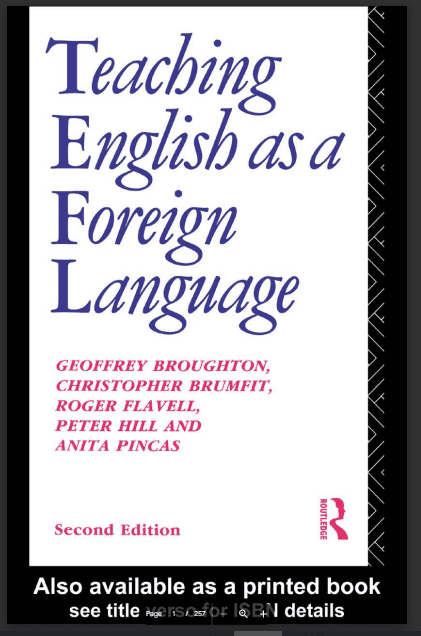
Teaching English as a Foreign Language is a professional text for the TEFL craft — teaching English as a foreign language — named plainly by its title. The post’s Download button is a Google Drive link, and the file it delivers is identified by the Drive page’s own title, ‘Teaching English As A Foreign Language Book.pdf’ — the title in the file’s own casing, with the file’s trailing ‘Book’ — the same volume under the filename it is served by. The book’s work is to equip the teacher of English in the foreign-language setting: where the classroom must supply the exposure that the surrounding world does not.
The foreign-language condition is easy to state and hard to teach inside. A child learning English in London is immersed whether school helps or not; a child learning it where no street sign, broadcast, or shopkeeper uses English gets exactly the hours the timetable gives — perhaps three a week — and forgets between them at a rate the teacher fights all year. Method in this setting is therefore not a preference but a compensation strategy. Input must be made comprehensible without translation’s shortcut, because a class sharing one mother tongue will always beg for it and a teacher who always grants it builds dependence instead of English. Practice must be engineered in volume — pair work multiplying speaking time thirty-fold over teacher-fronted talk — and error must be corrected with a surgeon’s selectivity, since correcting everything silences everyone. Layered over technique is the setting’s motivational economics: the learners’ need for English is real but distant — examinations, migration, jobs — and the teacher must lend it present-tense urgency through tasks whose success is felt now. A professional book for this field earns its place by respecting these constraints rather than importing methods designed for immersion; its reader teaches where English is a foreign language, and the honesty of that adjective in the title is the book’s whole programme.
What Learners Will Practise
Manufacturing Exposure
Teachers practise building the English environment the street withholds: classroom language in English, routines that run in English, and input graded to be understood without translation. The classroom becomes the country.
Engineering Practice Volume
The book practises the arithmetic of participation — pair and group structures that give every learner minutes of speech per lesson rather than seconds. Fluency is a function of volume honestly distributed.
Correcting Selectively
Readers practise the discipline of chosen correction: which errors to treat now, which to note for later, which to let pass in the service of courage. Correction is dosed like medicine, because it is one.
Key Features
The setting honesty is the feature: method designed for the foreign-language classroom’s actual constraints, not borrowed from immersion. The exposure craft is the second — comprehensible input without dependence on translation — and the shelf fit the third, the professional foundation beside this list’s chemistry partnership and its English-through-English doctrine. On this shelf it builds the classroom country here.
Who This Book Is For
Teachers of English in foreign-language settings are its first audience, new and experienced alike. Teacher trainers form its second readership, handed a text that makes method discussable. The professionally curious make its third, since few crafts hide as much design inside an ordinary-looking lesson.
How to Use This Book
Read it against your own timetable’s reality — your hours per week, your class size, your learners’ mother tongue — and adapt its methods to those numbers rather than to ideal ones. Trial one technique at a time for a full week before judging it. Keep it in the staffroom; professional books earn their keep in the breaks between lessons, not only in study.
Related Books
The shelf’s chemistry partnership stands at Chemistry for Students and Parents, and its English-through-English doctrine at Teaching English Through English Book.